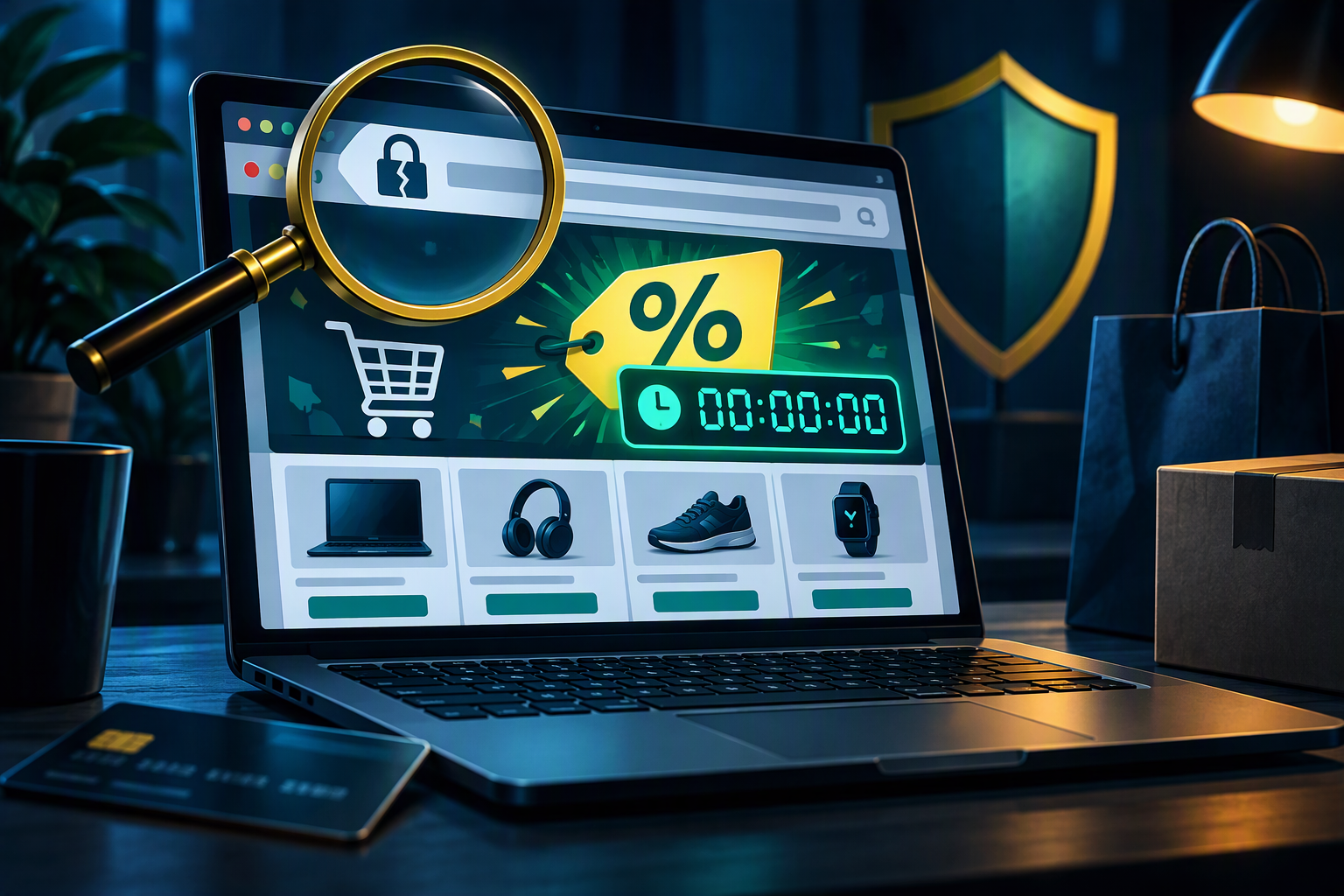
The jacket was $39 instead of $189. The site looked fine. The photos were sharp, there was a countdown clock, and the checkout took your card without a hiccup. That's how most fake stores get paid, and November is when they do their best business.
If you've ever wondered whether a store was real after you already clicked "Place Order," this is for you. It works better if you read it before.
Why the holidays make this worse
Online shopping was the second most reported fraud category to the FTC in 2024. The FBI says non-payment and non-delivery scams alone cost people more than $785 million that year. Those are only the people who reported it. A lot of shoppers never do, because the amount feels small or they're embarrassed.
November is when you shop fast. You've got six tabs open, you're comparing prices, and you're willing to try a store you've never used because the deal is good. Scammers plan around that. SI tools now let someone build a polished storefront with stolen product photos in an afternoon, so "it looks professional" tells you almost nothing anymore.
What a fake store looks like in practice
It usually starts with an ad on Facebook or Instagram, or a search result for something that's sold out everywhere else. The price is far below every other seller. You pay, and then one of three things happens. Nothing arrives. A cheap knockoff shows up weeks later. Or the order "ships" with a tracking number that goes nowhere while the store quietly keeps your card details.
None of that is visible on the checkout page. So you have to look at the store before you get there.
Five checks that take a few minutes
1. Compare the price. If the same item costs $189 at three stores you know and $39 here, that isn't a clearance. Real sales exist, but 80 percent off a current item from a shop nobody has heard of is the pattern.
2. Find the people behind it. Look for a real business name, a street address, and a phone number. Then search the address. If it turns out to be a house, an empty lot, or a different business, you have your answer. A contact form with no name on it isn't enough.
3. Check how old the site is. A free domain lookup shows when the website address was registered. A store that claims to have served customers "since 1998" but registered its domain three weeks ago isn't what it says. The URL Safety Investigator can look at the link for you.
4. Read reviews from somewhere else. Reviews on the store's own site prove nothing, because the store controls them. Search the store's name with the word "complaints" and see what comes back. Be suspicious of dozens of five-star reviews that were all posted in the same week and sound alike.
5. Look at how it wants to be paid. A credit card gives you the strongest dispute rights. Debit cards are weaker. Zelle, wire transfers, crypto, gift cards, and "send it to a friend" payments give you almost none, and a store that steers you toward them is telling you something.
The countdown clock test
Urgency is the oldest trick in the book, and fake stores love it. "Only 2 left." "Sale ends in 14:59." Reload the page. If the timer starts over, it was decoration. Real inventory doesn't reset when you hit refresh.
If you already ordered
Don't wait to see whether the package shows up. Take screenshots of the product page, your receipt, and any emails. Call the number on the back of your card and tell them you think the purchase was fraudulent. Disputes generally need to be filed within about 60 days of the statement date, so sooner is better.
Don't pay any "customs fee" or "reship fee" the store asks for afterward. That's a second hook. If you created an account and reused a password, change it everywhere you used it. Then report it at ReportFraud.ftc.gov and ic3.gov. Reports feed the lists other people check later.
Check it before you trust it
If something feels wrong, investigate it before you trust it. That's what Scamanot is for. Paste the store's link into the URL Safety Investigator or the Is This Legit Checker before you type in a card number. We don't store your searches.
Scamanot provides information to assist your own judgment. We do not guarantee the accuracy of findings or the legitimacy of any entity investigated.
Not sure if something is a scam? Run it through Scamanot — free investigations available, no account required.
Investigate Something Now