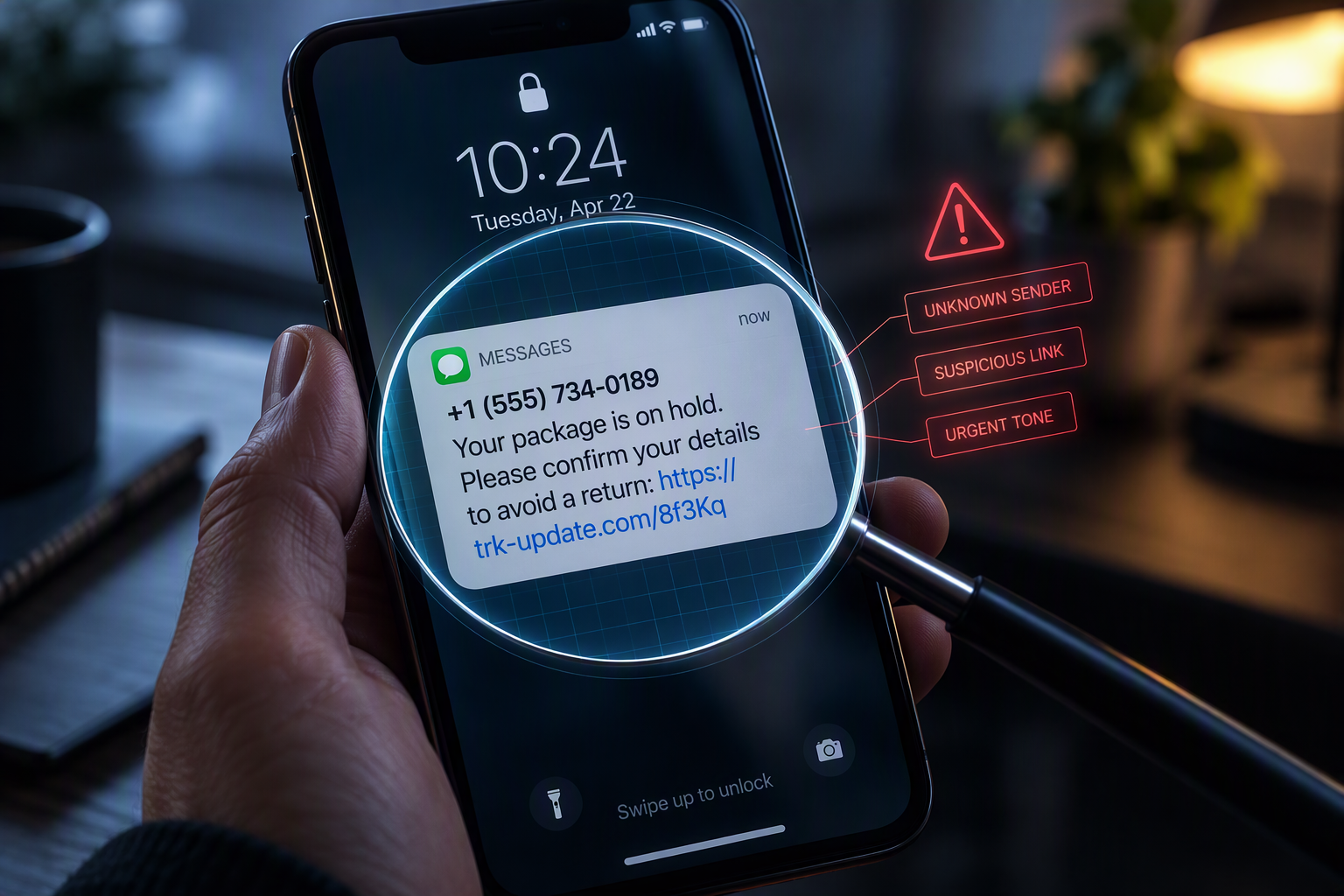
You get a text at 11pm from a number you don't recognize, claiming to be your bank's fraud department. Your first thought isn't "let me check a database." It's "is anyone watching for this stuff before it hits me?" That's the real question behind "real-time scam alerts," and the honest answer is more useful than the marketing term suggests.
Real-time monitoring is a real category of protection, and it does one thing well: it runs in the background of your phone or computer, watching texts, emails, and calls as they arrive, and flagging known patterns before you even open the message. Some antivirus suites build this in, Malwarebytes' Scam Guard being one example, as part of a broader security subscription. If you already pay for that kind of software, background scanning earns its keep. It's not a gimmick.
But most people asking "does this scam checker work in real time" aren't actually asking whether something watches their phone 24/7. They're asking a narrower, more urgent question: something just landed in my inbox, and I need to know right now if it's safe. That's a different problem, and it doesn't require background monitoring to solve. It requires a fast, direct answer to one specific thing.
Here's the distinction that actually matters: always-on monitoring is built to catch scams that match a known pattern. It's good at recognizing what's already been seen before. It's weaker on the thing that just happened to you personally, five minutes ago, that doesn't look like anything in a database yet. A rental listing with a landlord who's "traveling for work" and wants a wire transfer before you've seen the unit. A job offer that pays too well for how little the interview asked of you. A voice on the phone that sounds exactly like your grandson, except something about the story doesn't add up. These aren't always caught by pattern-matching, because scammers adjust their scripts constantly, specifically to avoid being caught by pattern-matching.
That's where on-demand investigation earns its place, sitting next to background monitoring rather than competing with it. Instead of scanning everything all the time, it takes the one specific thing you're suspicious of right now and actually investigates it: what's the pressure tactic being used, does the story hold together, what would a scammer running this exact play typically do next. You get an answer built around your situation, not a match against a list of scams other people have already reported.
If you're trying to decide which kind of protection you actually need, it comes down to what you're worried about. If your concern is "I want something watching in the background so I never see the scam text in the first place," that's a real-time monitoring feature, and it usually comes bundled with security software you're already paying for. If your concern is "something specific just happened and I need to know if it's a scam before I respond," that's an investigation, and it doesn't need a subscription or an app install to work. Scamanot was built for the second situation: describe the message, the listing, or the call, and get an answer built around your specific case, free, with nothing installed and nothing stored.
Neither approach replaces good judgment. A tool that watches in the background can still miss something new. A tool that investigates on demand can still get it wrong on limited information, which is why every Scamanot report comes with reasoning you can check yourself, not just a verdict. Scamanot provides information to assist your own judgment. We do not guarantee the accuracy of findings or the legitimacy of any entity investigated.
If something just landed in your inbox and it feels off, you don't need to wait for a security suite to catch up to it. Describe what happened, and Scamanot will investigate the specific situation in front of you, right now, for free.
Not sure if something is a scam? Run it through Scamanot — free investigations available, no account required.
Investigate Something Now